What Is the Apple M5 Chip?
The Apple M5 Chip is Apple’s fifth generation Mac and iPad processor, and it is the chip that now sits at the centre of most of Apple’s current computers. It was announced on 15 October 2025, alongside a new 14-inch MacBook Pro, a new iPad Pro and an updated Vision Pro. Those three devices went on sale on 22 October 2025. Since then the family has grown. A MacBook Air with the M5 arrived in March 2026, the M5 Pro and M5 Max followed the same month, and an M5 Ultra joined the Mac Studio in August 2026. If you are shopping for a Mac or an iPad today, there is a good chance the M5 is the chip you will be offered.
Apple describes the M5 as the next big leap in AI performance for Apple silicon. That is marketing language, but there is real engineering behind it. The base M5 is built on TSMC’s third-generation 3-nanometer process, known as N3P. It has a 10-core CPU and a 10-core GPU in its full version, a 16-core Neural Engine, and up to 32GB of unified memory with 153 GB/s of memory bandwidth. The biggest change is inside the graphics cores. Each GPU core now has its own Neural Accelerator, a small unit built for AI work. Apple says that lifts peak GPU compute for AI to more than four times the level of the M4. For everyday users, that should mean faster photo editing, smoother on-device AI features, and less waiting when an app leans on machine learning.
This guide pulls together what is confirmed, what early benchmarks show, and what is still rumour. It covers the specs in plain language, how the M5 compares with the M4, which devices have it, what it costs, and whether it is worth waiting for a newer chip instead. Prices and availability change, so treat the prices here as launch prices and check Apple’s site before you buy.
Apple M5 Chip Key Specifications
The base M5 is a system on a chip, which means the processor, graphics, memory and AI engine sit together in one package. That tight design is part of why Apple laptops are so efficient. Data does not have to travel far between parts, so less energy is wasted and the machine stays cooler.
Here are the confirmed core specs for the base M5, taken from Apple’s announcement and the detailed listings that followed it:
- CPU: up to 10 cores, made of 4 performance cores and 6 efficiency cores. Lower storage iPad Pro models use a 9-core version with one performance core disabled.
- GPU: up to 10 cores, with a Neural Accelerator in every GPU core. The base 13-inch MacBook Air uses an 8-core GPU version. Third-generation ray tracing, mesh shading and dynamic caching are supported.
- Neural Engine: 16 cores, rated at 42 TOPS, which is a measure of AI calculations per second.
- Memory: 16GB, 24GB or 32GB of unified LPDDR5X memory, depending on the device and configuration.
- Memory bandwidth: 153 GB/s, up from 120 GB/s on the M4.
- Process: TSMC third-generation 3-nanometer process, known as N3P.
- Clock speed: Apple does not publish clock speeds. Benchmark listings report a boost of up to about 4.61 GHz for the performance cores, against about 4.46 GHz for the M4.
That memory bandwidth jump is easy to overlook, but it matters a lot for AI work. Large language models and image tools move huge amounts of data through memory, and a faster pipe means less stalling. Apple raised bandwidth by roughly 30 percent over the M4, and that is one of the reasons the M5 feels quicker in AI tasks even when the raw CPU gain looks modest. For a wider sense of how device security fits with new hardware, our DigiCert data breach coverage is a useful reminder that a fast chip still needs good passwords and updates.
How Much Faster Is the Apple M5 Chip Than the M4?
Apple’s own claims set the tone. The company says the base M5 delivers up to 15 percent faster multithreaded CPU performance than the M4, up to 1.6 times better graphics performance in the MacBook Pro, and up to 3.5 times the AI performance of the M4, rising to about six times the level of the original M1. Those are Apple’s figures, measured on its own tests, so treat them as a guide rather than a promise for every task.
Early independent benchmarks tell a similar story, with some variation by device. A Geekbench listing for the M5 MacBook Pro reported about 4,263 points in single-core and 17,862 in multi-core. That is roughly 13 percent faster in single-core and about 17 percent faster in multi-core than the M4 averages reported alongside it. Other listings put the M5 at about 4,276 single-core and 17,862 multi-core, against about 3,777 and 14,818 for the 10-core M4. The exact numbers shift with the test version and the machine, but the pattern is steady. Single-core speed is up by roughly a tenth, multi-core by roughly a fifth.
Graphics show the bigger step. The M5’s 10-core GPU reaches about 5.1 TFLOPS of FP32 compute, against about 4.3 TFLOPS for the M4’s 10-core GPU. That is not a huge jump on paper, but the Neural Accelerator in each GPU core changes what the GPU can do for AI. Local image generation, background removal, transcription and on-device chat features run noticeably faster, and Apple says peak GPU AI compute is more than four times the M4 level. In practice, that means a video editor can apply AI noise reduction or smart reframing without sending the clip to the cloud, and a student can run a local AI study tool without waiting for a server.
For games, the M5 is a solid step up but not a revolution. It supports hardware ray tracing and MetalFX upscaling, and many current games run smoothly at Full HD with medium to high settings on a MacBook Air. If gaming is your main reason to buy, a MacBook Pro with an M5 Pro or M5 Max, or a dedicated gaming machine, will still serve you better. The base M5 is built for everyday speed and creative work first, and gaming second.
AI on Device: Why the Neural Accelerator Matters
The most important idea in the M5 is not a single speed number. It is where the AI work happens. Apple has been pushing more AI on to the device itself, rather than sending your words, photos and voice to a server. That is faster when you are offline, and it keeps more of your data on your own machine. The M5 is built for that shift.
There are three parts to it. The 16-core Neural Engine handles the steady AI jobs, like text prediction, live captions and photo sorting. The Neural Accelerator in each GPU core handles the heavy parallel work, like generating images or running a local language model. The faster unified memory feeds both of them without choking. Together, they let apps use Apple’s Foundation Models framework, introduced at WWDC25, which gives developers direct access to the on-device large language model behind Apple Intelligence.
What does that mean in real use? Writing tools can summarise a long document without an internet connection. Photo apps can remove a stranger from a holiday picture in seconds. Video apps can isolate a voice from background noise while you edit. Developers can build AI features that work in a plane, a rural classroom, or an office with a strict privacy policy. None of this needs the cloud, and none of it needs you to upload your files to a stranger’s server to get a result.
There is a limit worth knowing. On-device AI is still bound by memory. A base M5 with 16GB can run many local models well, but the largest models will still be happier with 32GB, or with a Pro or Max chip. If your work is mostly writing, browsing, calls and light editing, 16GB is fine. If you plan to run local AI tools every day, consider 24GB or 32GB when you configure the machine.
Battery Life and Efficiency
Apple’s chips have always traded on efficiency, and the M5 keeps that reputation. Apple claims up to 24 hours of battery life for the M5 MacBook Pro, which is the kind of figure that changes how you use a laptop. You stop hunting for a socket in a cafe, and you stop carrying a charger for a normal working day. Real life is less generous than Apple’s test, which uses video playback, but reviewers consistently report a full day of mixed work with room to spare.
The MacBook Air is the best example of what efficiency buys you. It has no fan at all, so it is silent, and the M5 still delivers strong performance for its size. The Air uses the same chip as the Pro in most configurations, with an 8-core GPU in the cheapest 13-inch model, and it stays cool enough for a lap. That is only possible because the chip sips power when the load is light and only ramps up for short bursts.
Heat is still a factor if you push the machine hard. A long video export or a sustained AI job will warm the Air, and without a fan it will slow down a little to protect itself. The MacBook Pro, with its fan and larger body, holds its speed for longer. If your work is bursts of activity with pauses in between, the Air is ideal. If you render video for an hour at a time, the Pro is the safer choice.
Which Devices Have the Apple M5 Chip?
The M5 launched in three devices on 15 October 2025, and the range has widened since. Here is the confirmed list as of November 2026, with the launch prices Apple set at the time.
14-inch MacBook Pro with M5
The first Mac with the M5. It launched at $1,599 in October 2025, with 16GB to 32GB of memory and 512GB to 4TB of storage. It is the entry-level Pro, aimed at students, developers and creators who want a fan, a brighter screen and longer sustained performance than the Air, without paying for a Pro or Max chip. Apple later adjusted MacBook pricing, so check the current price before you buy.
iPad Pro with M5
The M5 iPad Pro comes in 11-inch and 13-inch sizes, starting at $999 and $1,299 at launch. It keeps the Tandem OLED display, adds Wi-Fi 7 and a faster cellular modem, and is the most powerful tablet Apple has made. For illustrators, video editors and note takers who want a tablet that can genuinely replace a laptop for many tasks, this is the model to look at. Lower storage versions use the 9-core M5, while 1TB and 2TB versions get the full 10-core chip.
Vision Pro with M5
The updated Vision Pro swaps the old M2 for the M5, adds a softer Dual Knit Band in the box, and improves display rendering by about 10 percent, with refresh rates up to 120Hz against 100Hz before. Apple says AI features run about 50 percent faster on the new headset. Battery life is about 2.5 hours for general use, or 3 hours for video playback. It remains a niche, expensive device, but the M5 makes it noticeably more capable for spatial work and media.
MacBook Air with M5
The MacBook Air got the M5 on 3 March 2026, in 13-inch and 15-inch sizes. Launch prices were $1,099 for the 13-inch and $1,299 for the 15-inch, with 512GB of storage as standard, double the old base. Pre-orders opened on 4 March and the machines reached shops on 11 March. This is the M5 most people should buy. It is light, silent, fast enough for almost everything, and far cheaper than the Pro.
MacBook Pro with M5 Pro and M5 Max
On the same day, 3 March 2026, Apple introduced the M5 Pro and M5 Max alongside updated MacBook Pro models. Both use a Fusion Architecture that joins two dies into a single chip. They have up to 18 CPU cores, with 6 super cores and 12 performance cores and no efficiency cores at all. The Pro has up to 20 GPU cores, 64GB of memory and 307 GB/s of bandwidth. The Max has up to 40 GPU cores, 128GB of memory and 614 GB/s. Apple claims up to 30 percent faster multithreaded CPU performance than the M4 Pro and M4 Max, and more than four times the peak GPU AI compute. In October 2026 Apple also launched a touchscreen OLED MacBook Pro with M5 Pro and M5 Max, starting at $2,899 for the 14-inch model.
Mac Studio with M5 Ultra
In August 2026 Apple introduced the M5 Ultra with an updated Mac Studio. It is the workstation version of the family, with up to 36 CPU cores, up to 80 GPU cores and up to 512GB of memory. It is built for film, 3D, scientific work and heavy AI training on a desktop. Most readers will never need it, but it shows how far the M5 design can stretch.
Apple M5 Chip Against the M4: A Simple Comparison
If you already own an M4 Mac, the M5 is an evolution, not a reason to upgrade on its own. Here is the short version, based on Apple’s figures and the benchmark listings above:
- CPU: about 10 to 15 percent faster in single-core, about 17 to 24 percent faster in multi-core, depending on the test and the machine.
- GPU: about 5.1 TFLOPS against about 4.3 TFLOPS for the 10-core M4, plus a Neural Accelerator in every GPU core for AI work.
- Memory: 153 GB/s against 120 GB/s, a roughly 30 percent jump, with the same 16GB to 32GB range on the base chip.
- AI: Apple claims up to 3.5 times the AI performance of the M4, and more than four times the peak GPU AI compute.
- Process: both are 3-nanometer chips, but the M5 uses the newer N3P process, which is more efficient.
- Battery: similar or slightly better in real use, with Apple claiming up to 24 hours for the M5 MacBook Pro.
The gap is real, but it is the kind of gap you notice in heavy work, not in email. If your M4 still feels fast, keep it. If you are buying new, the M5 is the obvious choice, because it will hold its value longer and it is built for the AI features Apple is adding now. For context on how Apple frames the launch, see TechCrunch’s report on the October 2025 M5 launch and Macworld’s coverage of the M5 announcement. The full chip family is also summarised on Wikipedia’s Apple M5 page.
What About the M6? Should You Wait?
This is the question every buyer asks, and in November 2026 it has a twist. Apple announced the M6 on 25 August 2026, in a new Mac mini that started shipping on 22 September. The M6 is Apple’s first 2-nanometer chip, with a 12-core CPU and a 12-core GPU, a dual Neural Engine, and 170 GB/s of memory bandwidth. Apple claims up to 1.2 times faster multithreaded CPU performance than the M5. Early Geekbench listings put it about 5 to 12 percent faster in single-core, depending on the test version.
Here is the catch. The M6 is, for now, a base chip only. It lives in the Mac mini, and reports say Apple will skip M6 Pro and M6 Max and move its high-end chips straight to the M7 generation. The fastest Mac laptops you can buy in November 2026 still run the M5 Pro and M5 Max, including the new touchscreen OLED MacBook Pro. An M6 MacBook Air is reported to be coming in early 2027, but Apple has not confirmed a date.
So should you wait? If you want a Mac mini, buy the M6 now, because it is already here and it is the fastest mini Apple has made. If you want a MacBook Air, and your current laptop still works, waiting a few months to see what the M6 Air brings is reasonable. If you need a powerful laptop now, buy an M5 Pro or M5 Max MacBook Pro and do not look back. It will be faster than a base M6 Air for heavy work, it has more memory and Thunderbolt 5, and it will stay useful for years. Waiting for a chip that has not been announced is only worth it if your current machine is still doing its job.
Is the Apple M5 Chip Worth It?
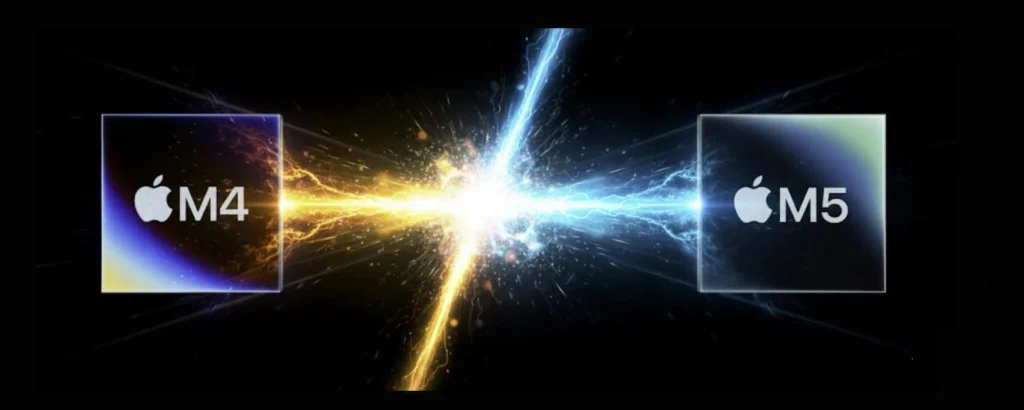
For most buyers, yes. The M5 is not a flashy redesign. It is a faster, smarter version of a chip that was already excellent, with its biggest gains in the places that matter next: AI, graphics and memory speed. The MacBook Air with the M5 is the best value in Apple’s range, and it is the machine most people should choose. The 14-inch MacBook Pro with the M5 is the right pick if you want a fan, a better screen and longer sustained speed. The iPad Pro with the M5 is the best tablet for creative work, and the Vision Pro with the M5 is a better headset, even if it is still a luxury.
There are two groups who should pause. The first is M4 owners whose machines still feel fast. You will not feel a 15 percent CPU gain in daily browsing and documents, and your money is better spent on more storage or a better display than on a new chip. The second is buyers who need the very fastest laptop and can wait. The M6 Air is rumoured for early 2027, and the M7 Pro and Max will follow after that. If your work is not urgent, a short wait could buy you a newer generation.
For everyone else, the advice is simple. Buy the M5 device that fits your work, get at least 16GB of memory, and choose 512GB of storage as a minimum, because modern apps and AI models eat space quickly. Keep the software updated, use a strong, unique password, and turn on two-factor authentication. A fast chip is only part of a safe setup. If you travel or work on public Wi-Fi with your new Mac, our guide to the best VPNs in 2026 explains which services are worth paying for and why a free VPN is often a false economy.
Frequently Asked Questions
When was the Apple M5 Chip released? Apple announced the base M5 on 15 October 2025, with the 14-inch MacBook Pro, iPad Pro and Vision Pro. Those devices went on sale on 22 October 2025. The MacBook Air with M5 followed on 3 March 2026.
What devices have the Apple M5 Chip? The 14-inch MacBook Pro, the 11-inch and 13-inch iPad Pro, the Vision Pro, and the 13-inch and 15-inch MacBook Air. The M5 Pro and M5 Max power higher-end MacBook Pro models, and the M5 Ultra powers the Mac Studio.
How fast is the Apple M5 Chip compared with the M4? Apple claims up to 15 percent faster multithreaded CPU performance and up to 3.5 times the AI performance. Early Geekbench listings show roughly 13 percent faster single-core and about 17 percent faster multi-core than the M4, with variation by device and test version.
How many cores does the Apple M5 Chip have? The full base M5 has a 10-core CPU, with 4 performance cores and 6 efficiency cores, and a 10-core GPU. Lower storage iPad Pro models use a 9-core CPU version, and the base 13-inch MacBook Air uses an 8-core GPU version.
How much memory does the Apple M5 Chip support? The base M5 supports 16GB, 24GB or 32GB of unified memory, with 153 GB/s of bandwidth. The M5 Pro supports up to 64GB and the M5 Max up to 128GB, while the M5 Ultra supports up to 512GB.
What is the Neural Accelerator in the Apple M5 Chip? It is a small AI unit built into every GPU core. Apple says it lifts peak GPU compute for AI to more than four times the level of the M4, which speeds up local image generation, transcription and other on-device AI tasks.
Is the Apple M5 Chip good for gaming? It is capable for casual and mid-range gaming, with hardware ray tracing and MetalFX upscaling, and many games run well at Full HD. For serious gaming, an M5 Pro or M5 Max MacBook Pro, or a dedicated gaming PC, is a better choice.
How much does a MacBook Air with the Apple M5 Chip cost? At launch in March 2026, the 13-inch model started at $1,099 and the 15-inch at $1,299, both with 512GB of storage. Prices have changed since then, so check Apple’s current price before you buy.
How much does a MacBook Pro with the Apple M5 Chip cost? The 14-inch MacBook Pro with the base M5 launched at $1,599 in October 2025. Higher-end models with the M5 Pro and M5 Max cost considerably more, with the touchscreen OLED model starting at $2,899.
Should I buy an M5 Mac or wait for the M6? If you need a machine now, buy the M5. The M6 is currently only in the Mac mini, and the fastest Mac laptops still use M5 Pro and M5 Max. If you want a MacBook Air and your current laptop still works, waiting to see the reported early 2027 M6 Air is reasonable.
Does the Apple M5 Chip improve battery life? Apple claims up to 24 hours for the M5 MacBook Pro. In real mixed use, most reviewers report a full working day with charge to spare, similar to or slightly better than the M4.
Is the Apple M5 Chip good for AI work? Yes, that is its main strength. The Neural Engine, the Neural Accelerator in each GPU core, and the faster 153 GB/s memory are built for on-device AI, including Apple’s Foundation Models framework and Apple Intelligence features.
Sources
Verified against TechCrunch, Apple upgrades iPad Pro, MacBook Pro, and Vision Pro with new M5 chip, 15 October 2025, Macworld, Apple heralds next big leap in AI performance with M5 chip launch, 15 October 2025, and Wikipedia, Apple M5, with benchmark figures from Notebookcheck and CPU-Monkey listings as cited in the text.